

Big Mathematics Day
| Primary education |
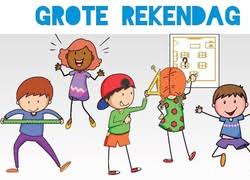
The day starts with a school-wide opening, in which all students actively participate. The students not only work on individual sums during the theme, but they also investigate mathematical problems and contexts (based on inquiry-based learning). The day is structured in such a way that, based on a few smaller assignments, a larger product is ultimately put down by the students. The students work together in heterogeneous groups within their construction, so that every child can contribute to the whole.
Themes
When selecting themes, consideration is given to whether they complement what is already offered in the maths textbooks. The content of the themes does fall within the core objectives for maths in primary education, but is often slightly on the fringes of what is customary (the working methods differ, there is slightly more room for discovery for the pupils).
| Title | Year | theme-website |
| 24 – Could this be correct? | 2026 |
|
| 23 – Fair share | 2025 | 1005 schools
|
| 22 – Data in the picture | 2024 | 970 schools
|
| 21 – The Waste Parade | 2023 | 1150 schools
|
| 20 – The Architect makes the construction | 2022 | 986 schools
|
| 19 – On a mathematical journey | 2021 | 724 schools
|
| 18 – The Number Factory | 2020 | 1250 schools
|
| 17 – Out of proportion | 2019 | 1235 schools
|
| 16 – The school as a warehouse | 2018 | 1499 schools
|
| 15 – Measuring, moving and constructing | 2017 | 1279 schools
|
| 14 – Let’s have a look behind the code | 2016 | 1301 schools
|
| 13 – Mathematics (geometry) and art | 2015 | 1275 schools
|
| 12 – Classroom statistics | 2014 | 1200 schools
|
| 11 – Amusement Park | 2013 | 904 schools
|
| 10 – Animals and Math | 2012 | 830 schools
|
| 9 – Are you sure? | 2011 | 869 schools
|
| 8 – Body measurement | 2010 | 985 schools
|
| 7 – Money | 2009 | 732 schools
|
| 6 – It’s about time | 2008 | 683 schools
|
| 5 – Geometry, patterns and art | 2007 | 673 schools
|
| 4 – Playing with numbers | 2006 | 637 schools
|
| 3 – Counting, tally, drawing. Collect, order and visualize | 2005 | 398 schools
|
| 2 – Geometry and measurement | 2004 | 509 schools
|
| 1 – Piloting the idea … | 2003 | 20 schools
|
Our reasons for developing a new BMD each year have not changed, and in fact the urgency has increased. This activity should focus on insight, on developing and using core mathematical ideas. This can be achieved through:
- Regularly have students solve open-ended problems;
- The teacher adopts a restrained approach, leaving the thinking to the students;
- Students work together, discussing their ideas;
- The teacher facilitates a discussion about underlying mathematical ideas.
But this is not what we observed in the schools 25 years ago, and we see it even less in the Dutch schools nowadays. After many years in which the Freudenthal approach (Realistic Mathematics Education, RME) was respected – but followed only superficially – we have new ‘political’ interference. In the public opinion, the performance of Dutch children in mathematics became perceived as declining. This was not substantiated by facts, but it resulted in an emphasis on traditional teaching. There is a general believe in ‘direct instruction’ as the best way to improve performance.
Thus what we see in schools nowadays is quite different from what ‘rich mathematics education’ should focus on. The current ’emphasis’ is on teaching procedures through demonstration and imitation. Insight is expected to develop through clear explanation by the teacher.
We must conclude that the ideas of RME do not resonate that much in mathematics teaching in the Netherlands. By organizing the BMD and other activities we hope to change the practice of teaching.
Research questions
The Big Mathematics Day (BMD) gives a strong opportunity to focus on cooperative research between the CN (the Chinese Universities involved) and NL (the Freudenthal Institute of Utrecht University). We perceive a gap between the ideals of RME and the daily practice in Dutch schools. This leads to questions like:
- Does the gap exist? What does RME say and what is the school practice?
- Is that gap experienced? Do teachers see the difference between a BMD activity and a method lesson? Do students see that difference?
- Would teachers and students like to have more education like the BMD?
- Does the BMD bring about changes in regular school lessons?
Cooperation with the Chinese counterparts could add to this:
- Is there a similar gap between ideals and practice in the Chinese schools (for example in the daily work of the ‘New Century Mathematics Textbooks’?
- Does organizing a Big Mathematics Day contribute to desired changes in teaching practices in the Chinese schools?
In the Freudenthal Institute we had insufficient resources to initiate this kind of research, although we published a lot in the more popular Dutch journals for (mathematics) education.
Cooperation with Chinese Universities is more than welcome: comparing the teaching practices in both countries and studying the effect of the BMD on teaching practice, could lead to a discussion about the actual practice of mathematics teaching in primary schools, and what RME has to offer to this practice.
- Jonker, V., Wijers, M., Abels, M. and Keijzer, R. (2016). Let’s have a look behind the code. The Big Mathematics Day 2016 (Netherlands) about coding without computer (PDF), PATT (pp. 8). De Bilt, the Netherlands: PATT.
- Van Galen, F. and Keijzer, R. (2016). Designing a Mathematics Day (PDF) Educational Designer, 3.
- Wijers, M. and Jonker, V. (2011). Change and counting: example from the Big Math Day 2010 (PDF). Utrecht: Utrecht University, Freudenthal Institute.
Dutch publications, see the dutch website on Grote Rekendag
- Dong, Y., Shao, Y., Zhou, D. and Liu, J. (2025). Experienced teachers’ beliefs about the conception of student creativity in primary mathematics (PDF) Educational Studies in Mathematics doi:10.1007/s10649-025-10474-1.
- Doorman, M., Bos, R., de Haan, D., Jonker, V., Mol, A. and Wijers, M. (2019). Making and Implementing a Mathematics Day Challenge as a Makerspace for Teams of Students (PDF) International Journal of Science and Mathematics Education, 17, 149––165 doi:10.1007/s10763-019-09995-y.
- Freudenthal, H. (1991). Revisiting mathematics education. China lectures (PDF). Dordrecht: Kluwer Academic Publishers.
- Huang, L., Doorman, L. M. and van Joolingen, W. R. (2020). Inquiry-Based Learning Practices in Lower-Secondary Mathematics Education Reported by Students from China and the Netherlands (PDF) International Journal of Science and Mathematics Education, 19(7) doi:10.1007/s10763-020-10122-5.
- Liu, Q., Liu, J., Zhang, J., Dong, Y. and Xie, Z. (2025). Researching the Development of China’s Mathematics Textbook for Primary Grades: A Participatory Action Research Study (PDF) ZDM – Mathematics Education, 57(5), 905–920 doi:10.1007/s11858-025-01682-3.
- Misailidou, C. and Keijzer, R. (2019). Making mathematics fun: the ‘fear room’ game (PDF), CERME 11.
- Wang, T., Tian, Y., Yang, J. and Liu, J. (2025). Opportunities to Learn Mathematical Modelling in NCM Primary Textbook: A Case Study of NCM Textbook for Grade 6 (PDF). In (pp. 24–30): Springer Nature Singapore.
References
- groterekendag.nl (website)
- All years of the Big Maths Day

