

Crosscutting concepts
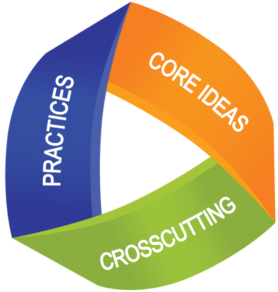
When these concepts, such as “cause and effect”, are made explicit for students, they can help students develop a coherent and scientifically-based view of the world around them.
Zie ook Big ideas, een vergelijkbaar begrip bij wiskunde.
In Nederland wordt onderwijs in de bètavakken veelal vakspecifiek aangeboden. Dat heeft voordelen, maar een nadeel is dat leerlingen weinig zicht krijgen op de samenhang tussen de bètadisciplines.
Eén van de mogelijkheden om leerlingen meer zicht te geven op samenhang tussen bètavakken, is om aandacht te besteden aan denkwijzen die karakteristiek zijn voor de gehele bètawetenschappen. In de Amerikaanse standaarden (2005) voor het science onderwijs worden dit crosscutting concepts genoemd. In de kennisbasis voor de onderbouw VO vinden we negen van deze karakteristieke denkwijzen, toegepast op de gebieden natuurkunde, biologie, scheikunde, techniek en fysische geografie. Uiteraard kunnen crosscutting concepts met meer diepgang aan de orde komen in de bovenbouw van havo en vwo.
1. Patterns. Observed patterns of forms and events guide organization and classification, and they prompt questions about relationships and the factors that influence them.
2. Cause and effect: Mechanism and explanation. Events have causes, sometimes simple, sometimes multifaceted. A major activity of science is investigating and explaining causal relationships and the mechanisms by which they are mediated. Such mechanisms can then be tested across given contexts and used to predict and explain events in new contexts.
3. Scale, proportion, and quantity. In considering phenomena, it is critical to recognize what is relevant at different measures of size, time, and energy and to recognize how changes in scale, proportion, or quantity affect a system’s structure or performance.
4. Systems and system models. Defining the system under study—specifying its boundaries and making explicit a model of that system—provides tools for understanding and testing ideas that are applicable throughout science and engineering.
5. Energy and matter: Flows, cycles, and conservation. Tracking fluxes of energy and matter into, out of, and within systems helps one understand the systems’ possibilities and limitations.
6. Structure and function. The way in which an object or living thing is shaped and its substructure determine many of its properties and functions.
7. Stability and change. For natural and built systems alike, conditions of stability and determinants of rates of change or evolution of a system are critical elements of study.
Verwijzingen
- Quinn, H., Schweingruber, H., & Keller, T. (Eds.). (2005). A framework for K-12. Practices, Crosscutting Concepts, and Core Ideas. National Academies Press. .
- Cobb, P., Confrey, J., diSessa, A., Lehrer, R., & Schauble, L. (2003). Design Experiments in Educational Research. Educational Researcher, 32(1), 9-13, Article 2700.
- Quinn, H. (Ed.). (2011). A Framework for K-12 Science Education: Practices, Crosscutting Concepts, and Core Ideas. The National Academies Press. .
- Verhoeff, R. P., Knippels, M.-C. P. J., Gilissen, M. G. R., & Boersma, K. T. (2018). The Theoretical Nature of Systems Thinking. Perspectives on Systems Thinking in Biology Education. Frontiers in Education, 3.
